
68 Harley Street London, W1G 7HE · Main Office
Also at Cromwell & Syon Bishops Wood · Multiple Locations
0203 9838 001 Call for Appointments
jessica@oneheartclinic.com Rapid Response to Enquiries
Expert London Cardiologist for your Heart Health
Vasospastic Angina & Prinzmetal's
Chest pain at rest, at night, or in the early morning — despite apparently normal coronary arteries. Coronary vasospasm is under-diagnosed in the UK and requires specialist provocation testing to identify with certainty.

Overview
Coronary vasospasm is a transient, severe contraction of a coronary artery wall — a spasm — that significantly reduces or temporarily stops blood flow to the heart muscle it supplies. Unlike obstructive coronary disease, where a fixed atherosclerotic narrowing restricts flow, the coronary arteries in vasospasm appear structurally normal between episodes. The problem is one of abnormal vascular tone rather than fixed anatomical disease.
The condition has been known by several names over the decades. Prinzmetal's angina — described by Myron Prinzmetal in 1959 — refers to the classic form: chest pain at rest accompanied by transient ST-segment elevation on the ECG, reflecting transmural ischaemia. The broader term vasospastic angina encompasses both epicardial coronary spasm and microvascular vasospasm, which produce similar symptoms but through slightly different mechanisms. Both fall within the INOCA framework.
The mechanism involves an abnormal response of the coronary smooth muscle cells to physiological stimuli — including acetylcholine, serotonin, histamine, and catecholamines — that normally cause modest vasoconstriction but trigger an exaggerated and prolonged spasm in susceptible individuals. Endothelial dysfunction — impaired production of nitric oxide and prostacyclin, which normally maintain vasodilatory tone — is a key underlying factor.
The angiogram is normal because the spasm is intermittent. The absence of fixed disease does not mean the coronary artery behaves normally — only that it looks normal on a single, non-provoked study.
The Diagnostic Problem
Coronary vasospasm is more common than is widely appreciated in UK clinical practice. Several factors combine to make it systematically under-diagnosed.
First, symptoms typically occur at rest — often at night or in the early morning — making standard exercise testing unreliable. A stress test designed to provoke ischaemia through exertion will frequently be normal in a patient whose symptoms are entirely rest-related. A normal stress test is therefore insufficient to exclude vasospasm.
Second, the ECG changes that confirm the diagnosis — ST-segment elevation during pain — are transient and may have resolved by the time the patient reaches an emergency department or GP surgery. Without documentation of the ECG during an episode, the diagnosis cannot be confirmed by standard means.
Third, the gold-standard test — intracoronary acetylcholine provocation — requires catheterisation and is not routinely performed in UK catheter laboratories at the time of diagnostic angiography. Most centres only perform acetylcholine testing when a specialist explicitly requests it.
The practical consequence is that many patients receive a diagnosis of non-specific chest pain, atypical angina, or functional symptoms — and are discharged without treatment that could meaningfully reduce their risk and relieve their symptoms.
Clinical Presentation
The timing and context of symptoms provides important diagnostic clues. Vasospastic angina has characteristic patterns that differ from exertional angina and from non-cardiac chest pain.
Symptoms typically present as central chest tightness, pressure, or pain — often severe in character — that may radiate into the left arm or jaw. Episodes usually last 5–15 minutes and may be accompanied by palpitations, sweating, or presyncope. Unlike stable angina, they occur predominantly at rest, often between midnight and 8am.
A proportion of patients with vasospasm do experience exertional symptoms as well — particularly in the early morning, when resting tone is heightened and the threshold for spasm is lower. This overlap with exertional angina can make clinical distinction difficult without objective testing.
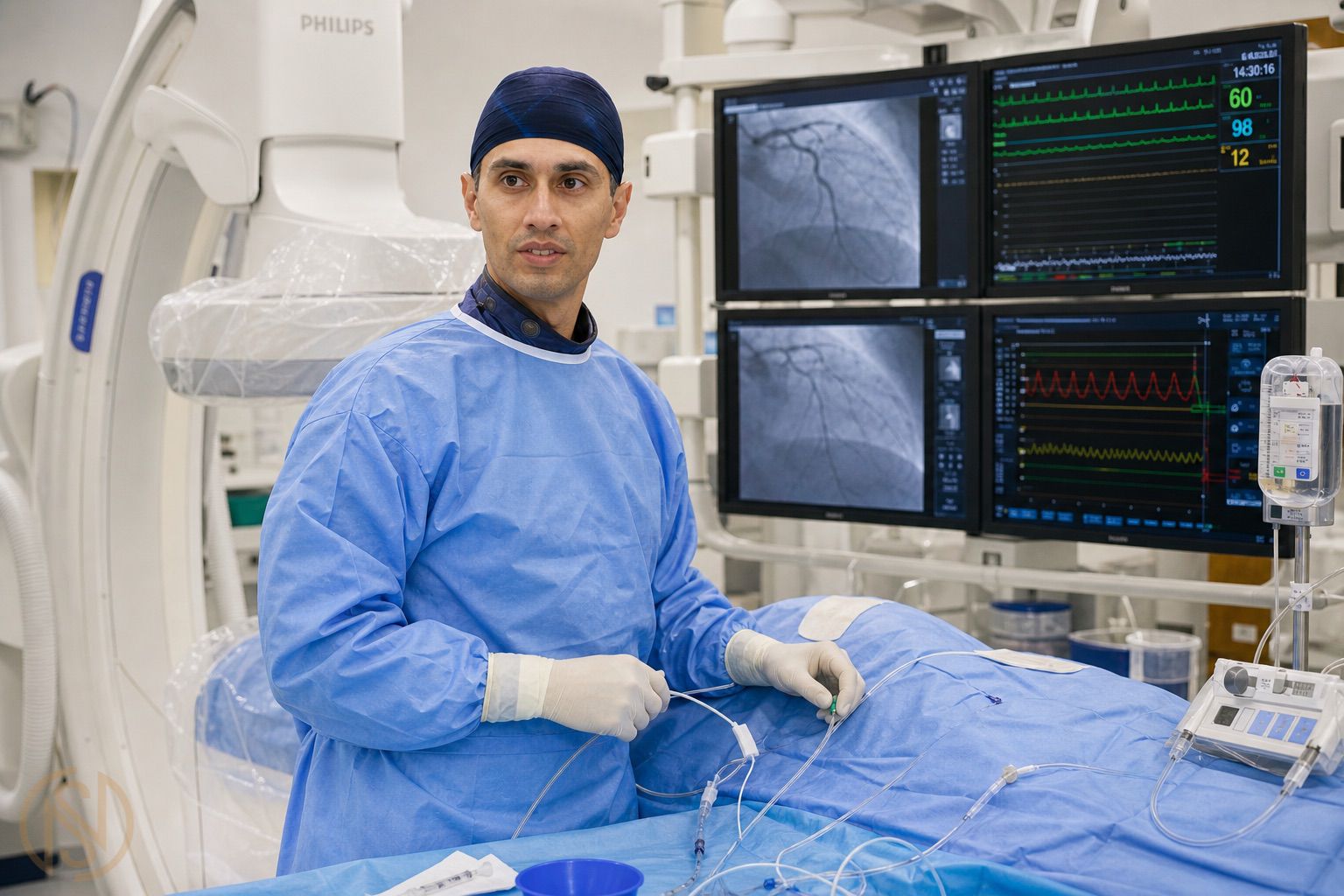
Specialist Testing
Diagnosis rests on documenting the ECG changes during a symptomatic episode — or, when this is not possible, provoking a controlled episode in the catheter laboratory.
Acetylcholine provocation testing requires both specialist expertise and the availability of the appropriate catheter laboratory set-up. Dr Nijjer performs this routinely as part of a comprehensive INOCA assessment — classifying the endotype to direct the correct treatment.
Important Overlap
MINOCA — Myocardial Infarction with Non-Obstructive Coronary Arteries — describes patients who present with a confirmed heart attack (elevated troponin, ECG changes) but in whom coronary angiography does not reveal significant obstructive disease. It is a diagnosis that requires further workup to establish the underlying cause, and coronary vasospasm is one of the most important mechanisms.
In a patient presenting with a troponin-positive acute coronary syndrome, normal or non-obstructive coronary arteries at angiography should trigger a systematic search for the underlying cause — vasospasm, microvascular dysfunction, myocarditis, takotsubo cardiomyopathy, and plaque erosion without flow-limiting stenosis are all possibilities. Each has distinct management implications.
Vasospasm causing MINOCA carries a meaningful risk of recurrent events — including recurrent myocardial infarction and sudden cardiac death — if left undiagnosed and untreated. A patient who has had a troponin-positive presentation with a normal angiogram should receive a comprehensive evaluation that specifically considers and tests for vasospasm, rather than simply being reassured that the arteries are clear.
Dr Nijjer performs complete MINOCA evaluations including intracoronary imaging (IVUS and OCT), comprehensive coronary physiology, and acetylcholine provocation, providing a definitive mechanistic diagnosis that directs the correct long-term management plan.
About Intracoronary Imaging (IVUS / OCT) →Management
Treatment targets abnormal coronary tone — directly relaxing the smooth muscle, reducing the stimuli that trigger spasm, and avoiding agents known to worsen it. The response to appropriate treatment is usually good, and many patients achieve significant symptom reduction.
Non-selective beta-blockers — including propranolol — should be avoided in vasospastic angina. By blocking beta-2 receptors, they leave alpha-adrenergic vasoconstriction unopposed and can precipitate or worsen spasm. This is a clinically important distinction from management of obstructive coronary disease.

Longer-Term Outlook
The prognosis for coronary vasospasm is generally favourable with appropriate treatment. In patients with isolated vasospasm, no fixed coronary disease, and a good response to calcium-channel blockers and nitrates, the risk of major cardiac events is low.
Prognosis is less favourable in patients with coexisting obstructive coronary disease, in those with multi-vessel spasm, or in those presenting with a prior MINOCA event. The occurrence of ventricular arrhythmia during a spontaneous episode — which can rarely cause syncope or aborted sudden cardiac death — is an indicator of higher risk that requires specialist review and, in some cases, consideration of an implantable cardioverter-defibrillator.
Long-term follow-up is appropriate in all patients with confirmed vasospastic angina. Symptoms can fluctuate — many patients have periods of remission followed by recurrence, sometimes triggered by life events, change of medication, or concurrent illness. Medication adjustments may be required over time, and a cardiologist with experience in vasomotor disease should remain involved in ongoing care.
Spontaneous remission occurs in a proportion of patients over five to ten years, particularly those without coexisting atherosclerosis. Smoking cessation is the single most impactful lifestyle modification and substantially reduces recurrence risk.
Common Questions
Prinzmetal's angina is an older term for the classic presentation of epicardial coronary vasospasm: rest pain with transient ST-elevation on the ECG. Coronary vasospasm or vasospastic angina is the broader term used today, encompassing both epicardial and microvascular spasm. The distinction matters because microvascular spasm does not produce visible constriction on angiography and requires a different diagnostic approach.
In most patients, vasospastic angina is manageable and carries a low absolute risk of major events with appropriate treatment. In a minority, vasospasm can trigger ventricular arrhythmia — particularly when it is prolonged or involves a large territory — and this can rarely cause syncope or, in the most severe cases, sudden cardiac death. Patients with severe, multi-vessel, or arrhythmia-associated vasospasm require specialist evaluation and close follow-up.
Non-selective beta-blockers block both beta-1 and beta-2 adrenergic receptors. Blocking beta-2 removes a vasodilatory signal from the coronary artery, leaving the alpha-adrenergic vasoconstriction pathway unopposed. In patients with a tendency to vasospasm, this imbalance can precipitate or worsen episodes. Cardioselective beta-blockers carry less risk but should still be used cautiously. Calcium-channel blockers are the preferred agent.
MINOCA is Myocardial Infarction with Non-Obstructive Coronary Arteries — a heart attack confirmed by raised troponin and ECG changes, but with a normal or near-normal angiogram. Coronary vasospasm is one of the most important underlying causes of MINOCA. Every patient with MINOCA should receive a systematic assessment to establish the mechanism, including testing for vasospasm, because the treatment and prognosis differ significantly between causes.
Further Reading
The European Society of Cardiology has published guidelines on vasomotor disorders. Dr Nijjer's research on coronary physiology and vasomotor function is available via PubMed.
Related Conditions
Dr Nijjer performs acetylcholine provocation testing and comprehensive INOCA assessment at his Harley Street practice. Same-week appointments available. All major insurers recognised.