
Patient Story
Can Fit People Develop
Heart Disease?
One patient's journey from an unexpected diagnosis to a full recovery — with Dr Nijjer's care at every stage. Shared with John's permission.
I have always been active — running, swimming, cycling, pushing weights and horse-riding. I was the last person you would expect to have a potentially serious heart condition.
John Curtis — Patient
The First Warning Sign
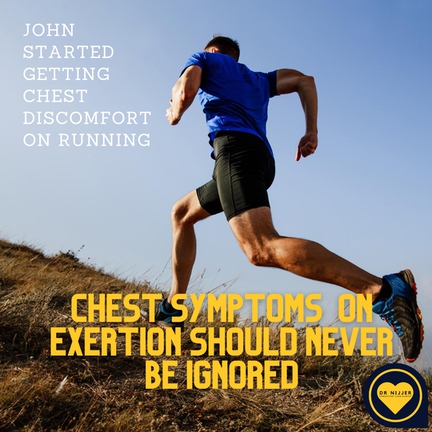
Chest Tightness on Running — a sign that should never be ignored
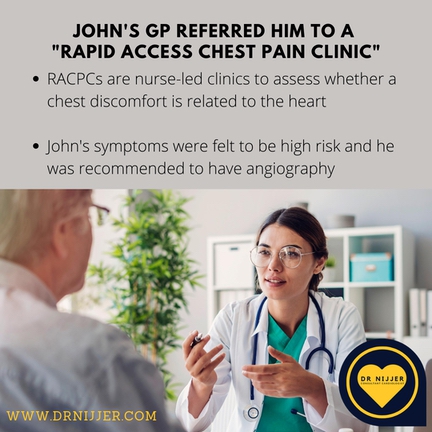
It was during a run last December that I felt an odd tightening in my chest. I saw my GP at my wife's insistence and was sent to a rapid-access chest pain clinic to investigate my symptoms due to my family history. Both my father and grandfather had serious heart conditions.
At the clinic, an ECG test showed that my heart was not working normally. I was referred to Dr Sukhjinder Nijjer, a Consultant Cardiologist at Hammersmith Hospital, for more tests.
What is Angina?
Angina is chest tightness or pain caused by the heart muscle not receiving enough blood during exertion. It occurs when the coronary arteries — the vessels that supply the heart — become narrowed by a build-up of fatty deposits called atherosclerotic plaque.
At rest, the narrowed artery may deliver enough blood. During exercise, when the heart demands more, the restricted flow produces the characteristic squeezing or pressure. The symptom typically resolves within minutes of stopping.
Angina is a warning sign of coronary heart disease — and a signal that investigation and treatment are needed to prevent a heart attack.
The Diagnosis
Coronary Angiography — seeing inside the heart arteries
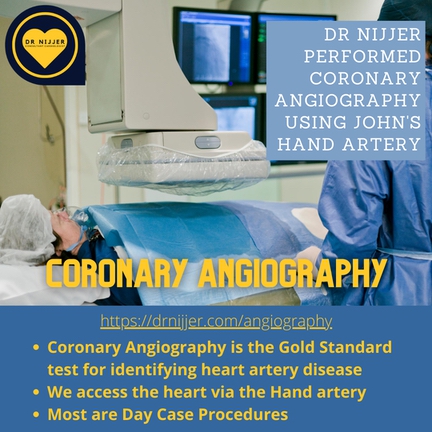
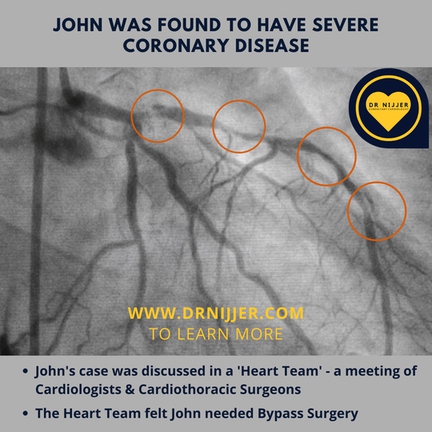
Dr Nijjer carried out a coronary angiogram — an x-ray test to show whether your arteries supplying blood to the heart are blocked or narrowed.
While looking at the images, he told me I would need coronary artery bypass surgery because one of my arteries was so blocked I was at risk of a heart attack. I had no idea I had such a serious heart condition.
Fortunately, Dr Nijjer explained my scans and treatment to my wife and I in a thorough and professional manner. He referred us on to Mr Jonathan Anderson as “a man I would trust with my own life.” We left feeling in very good hands.
What is Coronary Angiography?
Coronary angiography is the gold standard test for assessing the coronary arteries. A thin catheter is passed through the wrist or groin artery and guided to the heart under X-ray guidance.
A small amount of contrast dye is injected directly into each coronary artery, making blockages and narrowings clearly visible. The location, severity, and extent of any disease can be assessed in real time.
The findings determine whether the best treatment is medical therapy, coronary angioplasty (stenting), or bypass surgery — a decision guided entirely by the anatomy of the disease.
The Operation
Coronary Artery Bypass Surgery — creating new routes for the heart
My care plan was rapidly put into action — it was a huge relief to have treatment so soon after diagnosis. I saw Mr Jonathan Anderson the very next day. Two days later I was admitted to the Robert & Lisa Sainsbury Wing for my bypass operation, which Mr Anderson performed the following morning.
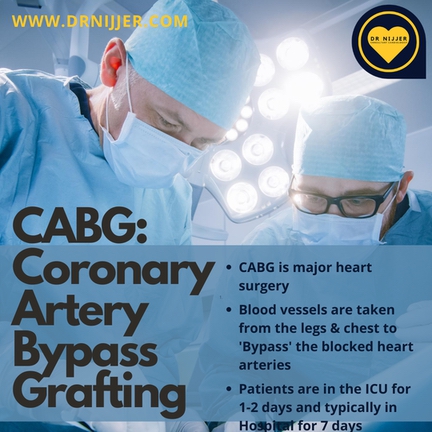
The procedure lasted about four hours and involved taking a spare blood vessel from within the chest and one from my leg, and attaching them to the heart below the blockage to enable healthy blood flow.
It is major open surgery, so I was in hospital for six days including three in intensive care. The standard of care was extremely high — the nursing staff, doctors and surgeons all had an exceptional bedside manner and listened carefully to how I was feeling.
What is Coronary Artery Bypass Grafting?
Coronary artery bypass grafting (CABG) is open heart surgery that creates new routes for blood to flow around severely blocked coronary arteries. Blood vessels — typically the internal mammary artery from the chest wall and the saphenous vein from the leg — are used as bypass conduits.
Each graft is sewn onto the coronary artery beyond the blockage, restoring full blood supply to the heart muscle. The procedure is performed under general anaesthetic and takes approximately 3–5 hours.
CABG is preferred over stenting when multiple arteries are severely diseased or when the anatomy makes surgery the superior long-term solution.
The Road Back
Cardiac Rehabilitation — rebuilding fitness and confidence
I was discharged on Christmas morning in time to sit at the head of the table with my family. Once home I wanted to return to normal, but I had just had major surgery — I was exhausted, my muscles had wasted and I had lost weight. I started going on walks, riding a spin bike, and gradually incorporating short runs.
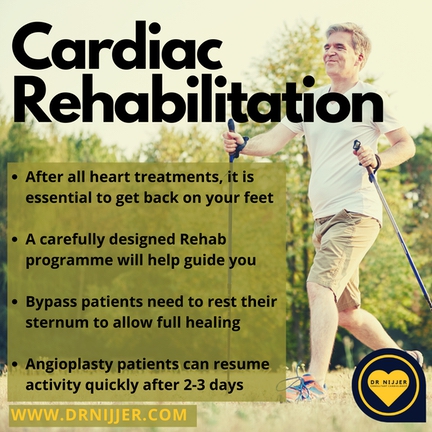
Even as a very fit heart patient, I was referred to Imperial Private Healthcare's rehabilitation service at Charing Cross Hospital for supervised exercise classes. I had my heart tested at constant workload at the start and end of the programme. My heart rate decreased by 30 beats per minute for the same work over nine weeks — a remarkable demonstration of how the heart recovers.
What is Cardiac Rehabilitation?
Cardiac rehabilitation is a structured programme of supervised exercise, education, and support designed to help patients recover safely after surgery or a cardiac event. It typically runs over 8–12 weeks.
Sessions combine monitored exercise with guidance on diet, stress management, medication, and return to activity. The heart becomes measurably more efficient — performing the same work at a lower heart rate, as John experienced.
Research consistently shows that patients who complete cardiac rehabilitation have significantly lower readmission rates and improved long-term survival compared to those who do not.
John’s Journey in Images
From Diagnosis to Full Recovery

I am very grateful for the care I received from Dr Nijjer to avert a potentially more serious heart condition and return to the things I enjoy. The access to the clinicians during my recovery was excellent. Now I am largely back to my previous fitness levels, and I intend to enjoy life's moments a little more.
John Curtis — now back to running, cycling & horse-riding
What Patients Say
Others Who Have Been in Good Hands
“Dr Nijjer clearly described all the processes and procedures I would be going through, and in the follow-up sessions described the findings and next steps in a clear and concise manner. He always made sure I fully understood each step, which gave me great confidence that my health and wellbeing were in good hands.”
Verified Patient
“Dr Nijjer has a very warm manner — he gave me information in an easy to understand way, including hand-drawn pictures, and was happy to answer all my questions. He found me a brilliant surgeon, with excellent results. I am now fully recovered and back to full health. I can strongly recommend him.”
Verified Patient
“From my first consultation through to the cardiac operation, Dr Nijjer was candid, considerate and consummately professional. The treatment I needed was completely unexpected. Due to Dr Nijjer's management I was reassured the outcome would be very positive. My family and I owe a great deal to him and his team.”
Verified Patient
“Dr Nijjer is an extremely friendly, professional and courteous consultant who listens to your concerns and translates that into an ability to put you at ease despite your obvious anxiety. He inspires confidence in analysing your situation, which in turn aids your own feeling of wellbeing.”
Verified Patient
Worried about your heart health?
We understand how frightening it can be when you are worried about your heart. Dr Nijjer's team will act quickly to arrange an appointment and any tests required — often on the same day. Call now to see how we can help.