
68 Harley Street London, W1G 7HE · Main Office
Also at Cromwell & Syon Bishops Wood · Multiple Locations
0203 9838 001 Call for Appointments
ella@oneheartclinic.com Rapid Response to Enquiries
Expert London Cardiologist for your Heart Health
Intramyocardial Coronary Segment
A coronary artery that tunnels through the heart muscle wall rather than running along its surface. In some patients this causes significant exertional chest pain — in others it is found incidentally. Expert physiological assessment determines whether it is clinically significant.

Overview
In the normal anatomy of the heart, the coronary arteries travel along the outer surface of the heart — embedded in epicardial fat — before sending branches into the muscle. In myocardial bridging, a segment of a coronary artery takes a different course: it dips beneath the surface and runs for a distance through the muscle wall itself, before re-emerging. The overlying band of heart muscle is the myocardial bridge.
The segment of artery that runs within the muscle is called the tunnelled segment. Because heart muscle contracts and relaxes with every heartbeat, this tunnelled segment is subject to external compression during systole — the contraction phase. In most people, coronary flow predominantly occurs during diastole (the relaxation phase), so mild compression during systole is well-tolerated. In a proportion of patients, however — particularly those with a deep or long bridge, elevated heart rates, or coexisting microvascular disease — the compression is sufficient to impair diastolic flow as well, causing genuine myocardial ischaemia.
Myocardial bridging is most commonly found in the mid-segment of the left anterior descending artery (LAD) — the artery that supplies the front wall of the left ventricle — though bridges can occur in any coronary vessel. The prevalence on CT coronary angiography is considerably higher than previously appreciated, at 15–40% of the population, but the majority are shallow bridges with no haemodynamic significance.
The bridge itself is an anatomical finding — not inherently a disease. What matters clinically is whether it causes a physiologically significant reduction in blood flow during the cardiac cycle, and this cannot be determined from anatomy alone.
Clinical Significance
The most important initial question when myocardial bridging is identified is whether it is causing symptoms and physiological impairment — or whether it is an anatomical variant without clinical consequence. This determination requires both a careful symptom history and objective functional assessment.
A short, shallow bridge — typically less than 10–15mm in length, with systolic compression of less than 50% on angiography — is unlikely to cause significant impairment of blood flow. Found incidentally on CTCA or angiography in an asymptomatic patient, it requires no specific treatment, though follow-up is appropriate. These patients should avoid unnecessary procedures.
A longer or deeper bridge — particularly one associated with diastolic flow impairment on pressure-wire assessment — that correlates with a patient's exertional symptoms is clinically significant. Physiological testing demonstrating abnormal iFR or FFR values, particularly with dobutamine provocation to simulate exercise, confirms functional relevance and directs treatment. This group requires a tailored management plan.
The distinction between these two groups cannot be made on anatomical imaging alone — and this is the fundamental problem with how myocardial bridging is often managed. Many patients are either told it is incidental (and sent away without adequate functional assessment) or undergo unnecessary procedures before physiology has confirmed that treatment is indicated. Expert assessment prevents both errors.
Clinical Presentation
When a myocardial bridge causes haemodynamically significant flow impairment, the presenting symptoms overlap substantially with those of obstructive coronary disease and microvascular angina. The characteristic pattern, however, has some distinguishing features.
Exertional chest pain — tightness or pressure, typically central or left-sided — is the most common symptom. It is classically associated with elevated heart rates: exercise, emotional stress, caffeine, and other sympathomimetic stimuli all increase heart rate, which in turn increases the proportion of the cardiac cycle spent in systole, worsening the compressive effect on the tunnelled segment. This heart-rate dependency is an important clinical clue and also informs the treatment strategy.
Some patients report palpitations — either because the ischaemia triggered by the bridge causes arrhythmia, or because an underlying rhythm abnormality (such as supraventricular tachycardia) raises heart rate enough to unmask haemodynamically significant bridging. In rare cases, typically those with very deep, long bridges in young patients, ventricular arrhythmia and sudden cardiac death have been reported — though this is not the typical outcome and should not cause unnecessary alarm in the broader population with bridging.
Breathlessness on exertion, reduced exercise tolerance, and an inability to sustain a target heart rate during training are all features seen in competitive athletes with significant bridging — a group in whom the condition has particular relevance.
Specialist Assessment
Diagnosis requires a two-stage approach: first establishing the anatomy, then quantifying the physiological impact. Both are essential before any treatment decision is made.
CTCA precisely delineates the anatomy of the bridge — its length, depth, and the extent of the tunnelled segment. It simultaneously excludes obstructive atherosclerotic disease, which can coexist with bridging and influences the treatment approach. In most cases, CTCA is the first investigation and provides the clearest anatomical picture.
The dynamic compression of the tunnelled segment — the characteristic "milking" appearance — is best appreciated on invasive angiography during coronary injection. This confirms the diagnosis and characterises the severity of systolic compression. The presence of diastolic flow abnormality is more difficult to assess angiographically, which is why pressure-wire assessment is required.
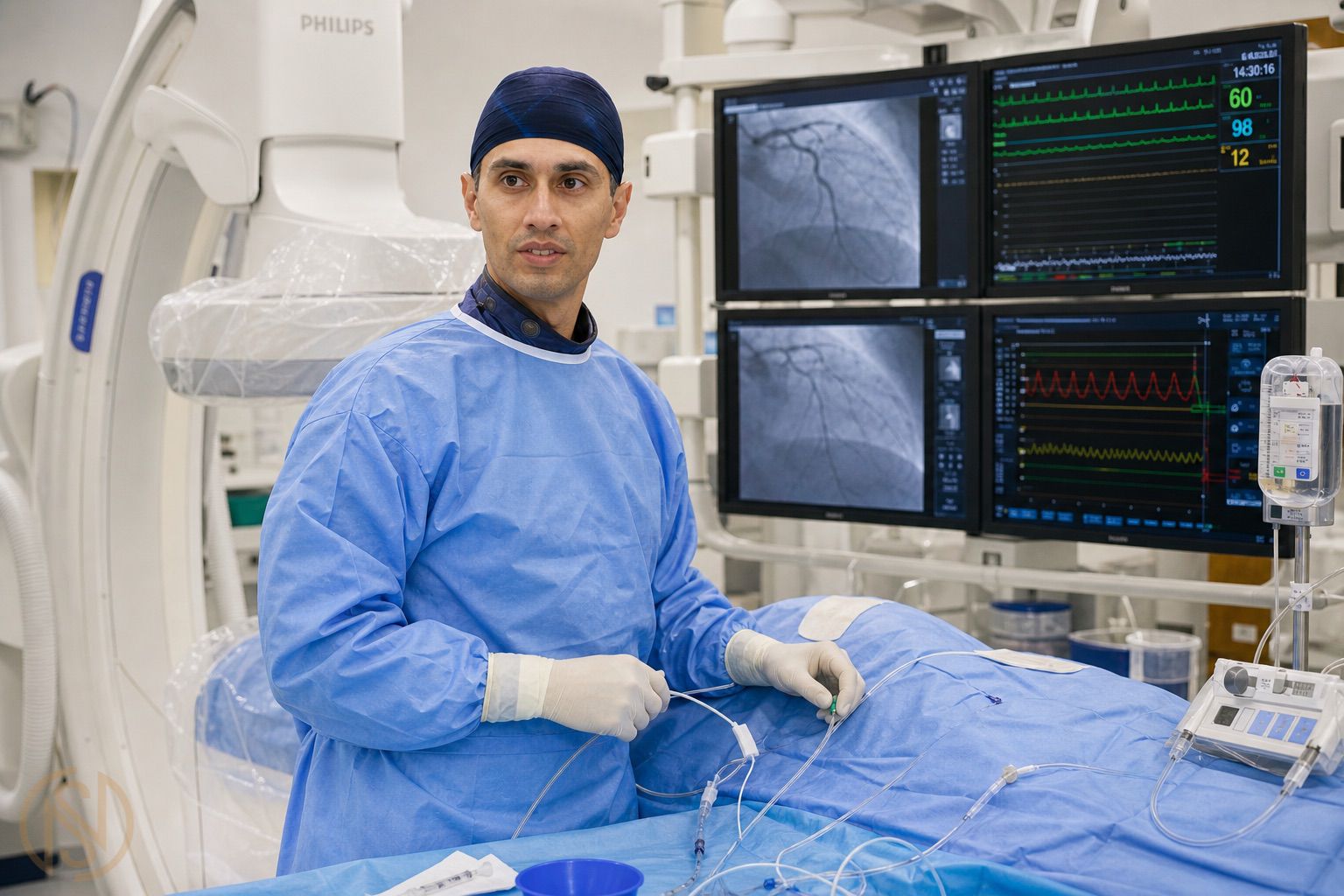
A pressure wire is positioned distal to the bridge to measure flow and pressure throughout the cardiac cycle. Diastolic wave-free period assessment — the same technology as iFR, developed by Dr Nijjer — is particularly well-suited to bridging evaluation because it specifically measures diastolic flow, where the compressive effect persists longest in significant bridges. Values within the ischaemic range confirm haemodynamic significance.
Because bridging is heart-rate dependent, a resting iFR may be borderline in a patient with symptoms only on exertion. Dobutamine infusion raises heart rate pharmacologically, simulating exercise. Reassessing pressure-wire values during dobutamine stress unmasks haemodynamically significant bridges that would be missed at rest — this is the most physiologically rigorous test available.

Management
Treatment is reserved for patients in whom the bridge has been confirmed as haemodynamically significant and correlated with their symptoms. Medical therapy is the first-line approach; surgical or interventional options are considered in a small minority of carefully selected patients.
Nitrates and vasodilators should be used with caution in myocardial bridging. By reducing blood pressure and increasing reflex heart rate, they can paradoxically worsen symptoms in some patients — in contrast to their beneficial role in obstructive coronary disease.
In a carefully selected minority of patients — those with severe haemodynamic impairment confirmed on physiology, refractory to optimal medical therapy, and whose anatomy is suitable — two further options exist:
Surgical unroofing involves dividing the overlying muscle bridge to release the tunnelled artery segment. It is the most definitive treatment and, in experienced hands, has excellent outcomes. It requires cardiac surgery and is reserved for those with severe, refractory disease.
Coronary stenting of the tunnelled segment has historically been performed but is now recognised to carry a significant risk of in-stent restenosis and stent fracture due to the repeated external compression — and is generally not recommended. Physiology-guided surgical unroofing is preferred where intervention is needed.
Specialist Input
Myocardial bridging sits at the intersection of anatomy, physiology, and clinical judgement. Getting the assessment right requires a cardiologist who understands all three — and who performs the physiological testing themselves.
The anatomical finding of a bridge is made on CT or angiography — but it tells only half the story. A long, deep-looking bridge may be physiologically irrelevant at rest. A moderate bridge may be highly significant during exertion. Only pressure-wire assessment — and specifically dobutamine-provoked pressure-wire assessment to simulate exercise — provides the definitive physiological answer.
The iFR technique — developed during Dr Nijjer's MRC-funded PhD at Imperial College — is particularly well-suited to this assessment. By measuring pressure and flow specifically during the diastolic wave-free period, it directly interrogates the part of the cardiac cycle where bridging has its greatest effect. Dr Nijjer has extensive experience applying this methodology to myocardial bridging, a condition where most cardiologists have limited exposure.
An incorrect conclusion — that the bridge is incidental when it is in fact causing ischaemia, or that it requires intervention when medical therapy would suffice — leads to either continued unexplained symptoms or an unnecessary procedure. Neither outcome serves the patient. The right assessment from the outset is the most important determinant of the right outcome.
About Coronary Physiology & iFR →Common Questions
Not necessarily. The majority of myocardial bridges are incidental findings with no haemodynamic significance. Whether you need further evaluation depends on whether you have symptoms — exertional chest pain, breathlessness, or palpitations — that correlate with the finding. If you are symptomatic, physiological assessment is appropriate. If the bridge was found incidentally in an otherwise asymptomatic person, close observation is usually all that is required.
Coronary artery disease (atherosclerosis) involves fixed plaque narrowing the arterial lumen. Myocardial bridging involves dynamic, external compression of a structurally normal arterial segment during each heartbeat. The mechanisms differ, the treatment approaches differ, and they require different diagnostic tools to assess. They can coexist in the same patient, which is an important consideration in assessment.
In most cases, no. Myocardial bridging is not a cause of classical plaque-rupture heart attack. However, in rare cases — typically those with very deep or long bridges — sustained ischaemia, vasospasm within the tunnelled segment, or ventricular arrhythmia triggered by ischaemia can cause a serious cardiac event. This is uncommon and relates to a minority of patients with severe bridging. In the majority of cases, the clinical course is determined by symptom burden rather than risk of acute events.
In most patients with an incidental or mildly significant bridge, exercise is appropriate and beneficial. In patients with confirmed haemodynamic significance, the approach depends on the severity of the physiological abnormality and whether symptoms are well-controlled on medical therapy. Competitive high-intensity sport may require specific guidance in the setting of severe bridging. This should be discussed with a specialist familiar with the condition.
Stenting the tunnelled segment is technically possible but is generally not recommended. Because the bridge compresses the segment with every heartbeat, stents placed here are subject to continuous external force — leading to a high rate of stent fracture and restenosis compared with stenting in conventional coronary disease. For patients who need an interventional approach, surgical unroofing of the bridge is preferred over stenting.
Further Reading
Dr Nijjer's research on coronary physiology — including the iFR technology central to diagnosing myocardial bridging — is indexed on PubMed. The British Heart Foundation provides general cardiac patient information.
Related Conditions & Tests
Expert physiological assessment — not just anatomical imaging — determines whether treatment is needed. Dr Nijjer offers same-week appointments at Harley Street. All major insurers recognised.